Bappenas Launches Blue Carbon Roadmap, Potential to Save 3.4 Gigatonnes of Carbon
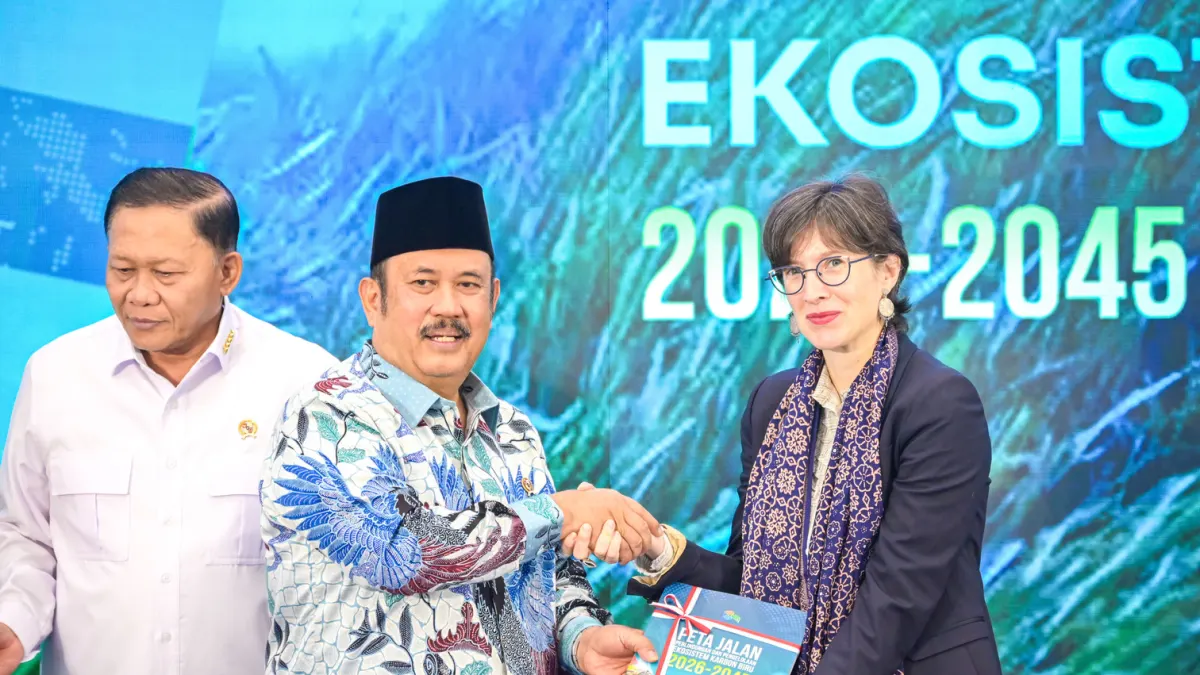
JAKARTA, GARISBUMI.com – Indonesia has around 3.45 million hectares of mangroves and 660 thousand hectares of seagrass beds which are estimated to be able to store up to 3.4 gigatons of carbon. This huge potential will now be managed through the Blue Carbon Ecosystem Protection and Management Roadmap 2026–2045.
The strategic document was launched by the Ministry of National Development Planning/National Development Planning Agency at the Bappenas Building, Jakarta, Monday (21/9/2026).
The road map was prepared by Bappenas together with the Indonesia Climate Change Trust Fund (ICCTF), with funding support from Agence Française de Développement (AFD) and implementation by the World Resources Institute (WRI) Indonesia.
This document is a cross-sector reference for strengthening the protection and sustainable management of coastal ecosystems towards a Golden Indonesia 2045.
Minister of National Development Planning/Head of Bappenas Rachmat Pambudy said mainstreaming blue carbon was needed to maintain a balance between economic growth, environmental carrying capacity and ecosystem sustainability.
"Through the launch of the Blue Carbon Ecosystem Protection and Management Roadmap 2026–2045, Indonesia is officially transforming its climate strategy from a land-based approach to an integrated land and sea strategy," said Rachmat.
Three Goals and Five Pillars of Blue Carbon
The road map carries the vision of realizing an Indonesian blue carbon ecosystem that is protected and managed optimally as a contribution to environmental sustainability, global climate resilience and the welfare of coastal communities.
This vision is translated into three main targets, namely nature, climate and society or Nature, Climate and People.
Its implementation is supported by five pillars, namely policy, regulation and planning; institutional; data and science; funding; and community empowerment.
Implementation of the roadmap will be carried out in stages until 2045. The stages start from strengthening the foundation, accelerating implementation, to ensuring long-term sustainability.
Apart from absorbing and storing carbon, mangrove and seagrass ecosystems play a role in strengthening coastal resilience to the impacts of climate change. The existence of this ecosystem also supports the sustainability of fisheries productivity and the economy of coastal communities.
The blue carbon roadmap is expected to open up innovative financing and investment opportunities, improve the quality of national data, and strengthen cross-sector policy integration.
Four Implementation Directions
Rachmat conveyed four main directions in implementing the Blue Carbon Ecosystem Protection and Management Roadmap 2026–2045.
First, the government needs to integrate policies and regulations across sectors. Second, build a one-stop data system as well as a measurement, reporting and verification or Measurement, Reporting and Verification (MRV) system that is credible, integrated and meets international standards.
Third, optimize innovative and sustainable financing schemes. Fourth, ensure that coastal communities receive benefits inclusively through increasing welfare, technical capacity and income.
"Our carbon does not only belong to Indonesia, but is also part of the world's ecosystem. Therefore, the technical capacity and income of coastal area communities must be prioritized," stressed Rachmat.
According to him, community involvement and welfare is an important part in ensuring the sustainability of blue carbon ecosystem management.
France Commits to Continue Support
AFD Indonesia Deputy Country Director Caroline Edant said AFD has supported ICCTF in preparing the blue carbon roadmap since 2022.
This support is expected to create a sustainable foundation for the protection and restoration of blue carbon ecosystems. Coastal ecosystems have an important role in facing the climate crisis through mitigation and adaptation.
Caroline stated that France is committed to continuing to work with the Indonesian Government to translate the roadmap into concrete action in the next few years.
Implementation of the roadmap until 2045 is expected to strengthen cross-sector program synergies, improve the quality of data and knowledge, and open access to green financing.
The government is also targeting increasing community capacity in protecting and managing coastal ecosystems so that environmental and economic benefits can go hand in hand.
Artikel ini merupakan siaran pers resmi yang diterbitkan melalui Meja Redaksi GARIS BUMI. Materi telah melalui peninjauan editorial untuk kenyamanan dan kejelasan informasi bagi pembaca.
Share Your Thoughts Editorial Moderation Required