9.8-Meter Sperm Whale Stranded in Ternate, KKP Reveals Condition
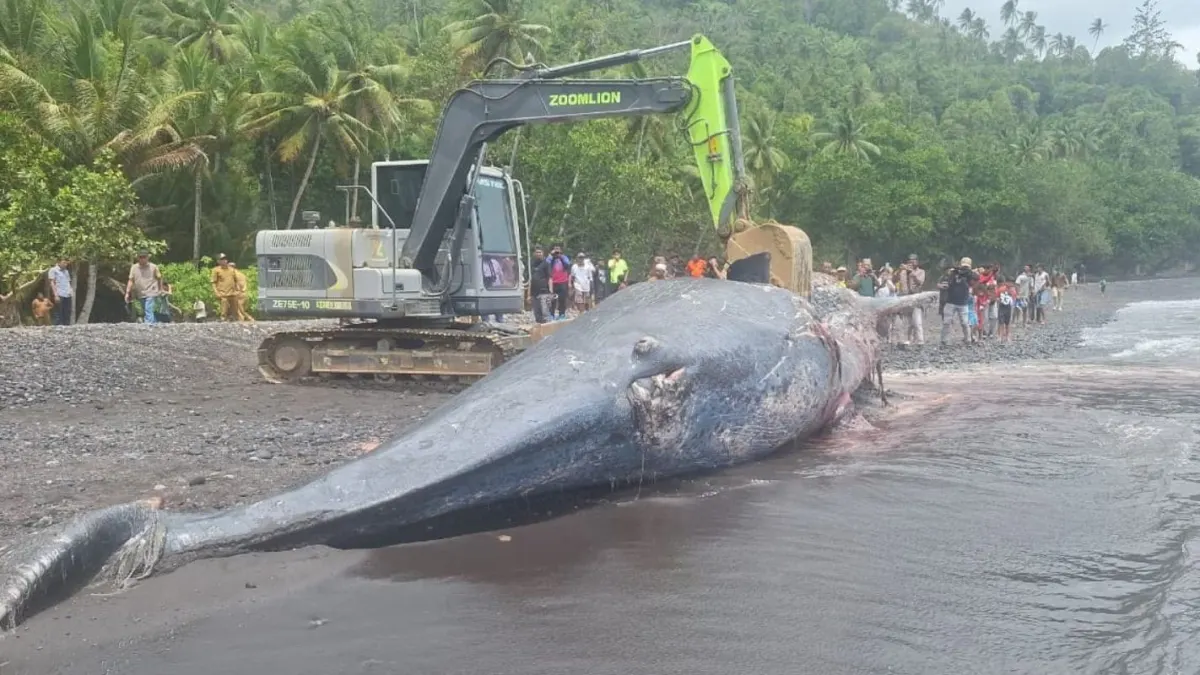
JAKARTA, GARISBUMI.com – A 9.8-meter-long female sperm whale was found stranded on the coast ofAfe-Taduma Beach, Afe-Taduma Village, Ternate Island District, Ternate City, North Maluku.
By the time it was found, the whale had died in a state of moderate decay. The Ministry of Marine Affairs and Fisheries together with the local government and the community then identified, measured, and buried the marine mammal carcass.
The Kupang Marine Management Center Team of the Sorong Service Unit of the Ternate Work Area received a report from the public regarding the stranded sperm whale on Tuesday, September 8, 2026.
Officers immediately visited the site and coordinated with the Regional Secretary of Ternate City, the Marine and Fisheries Office, the Environmental Agency, the sub-district and sub-district governments, and the local community.
The Head of the Kupang Marine Management Center, Imam Fauzi, appreciated the speed with which residents submitted reports as well as the support of the local government in handling the whale carcass.
“We greatly appreciate the ranks of the Ternate City Government and the people who are ready to report this incident. The awareness and synergy of various parties in the field greatly help the identification process until the burial of the whale carcass runs smoothly according to procedure," said Imam in an official release in Jakarta, Sunday, September 13, 2026.
Female Sperm Whales Undergoing Moderate Decay
Based on the results of identification at the location, the sperm whale is known to be female. The condition is categorized as moderate decay or code three, with the outer skin peeling off.
Officers also performed morphometric measurements to document the size and characteristics of the whale's body.
The measurement results show that the whale has a total length of 9.8 meters with a body circumference of 6.6 meters.
The length of the pectoral fin is 75 centimeters, the dorsal fin is 40 centimeters, and the tail is 2.8 meters long.
Morphometric data is required as part of documentation of handling stranded marine mammals. The information also supports the recording and monitoring of marine biota conditions in coastal areas.
Whale Carcass Buried Using Excavators
The large size of the whale's body makes the transfer process unable to be done manually. The joint team used an excavator to move the carcass while digging a burial pit.
The whale carcass was then buried not far from the discovery site. The site selection is carried out to facilitate periodic monitoring and inspection after the burial process.
Rapid carcass handling is needed to reduce the potential for disruption to beach cleanliness, community comfort, and surrounding environmental conditions.
Collaboration between institutions is also needed because handling large marine mammals requires adequate manpower, equipment, location, and coordination.
Community Reports Accelerate Handling
KKP emphasizes the importance of the role of the community in reporting the occurrence of stranded marine mammals. The information submitted quickly helps officers immediately conduct inspections and determine handling actions.
Community reports should ideally include the location of the discovery, the time of the incident, the condition of the animal, the approximate size, as well as photo or video documentation if possible and safe to do so.
People should also not touch, move, pick up body parts, or swarm too close to stranded marine mammals.
In addition to safety, contact restrictions are required so that the location and condition of the animal's body do not change before the officer identifies it.
The occurrence of stranded marine mammals requires the cooperation of the central government, local governments, technical officers, and coastal communities. The collaboration ensures that handling can be carried out quickly and according to procedures while supporting the monitoring of the health of marine ecosystems.
Share Your Thoughts Editorial Moderation Required