Five Regions in East Java Become Pilots for Circular Economy and Waste Management
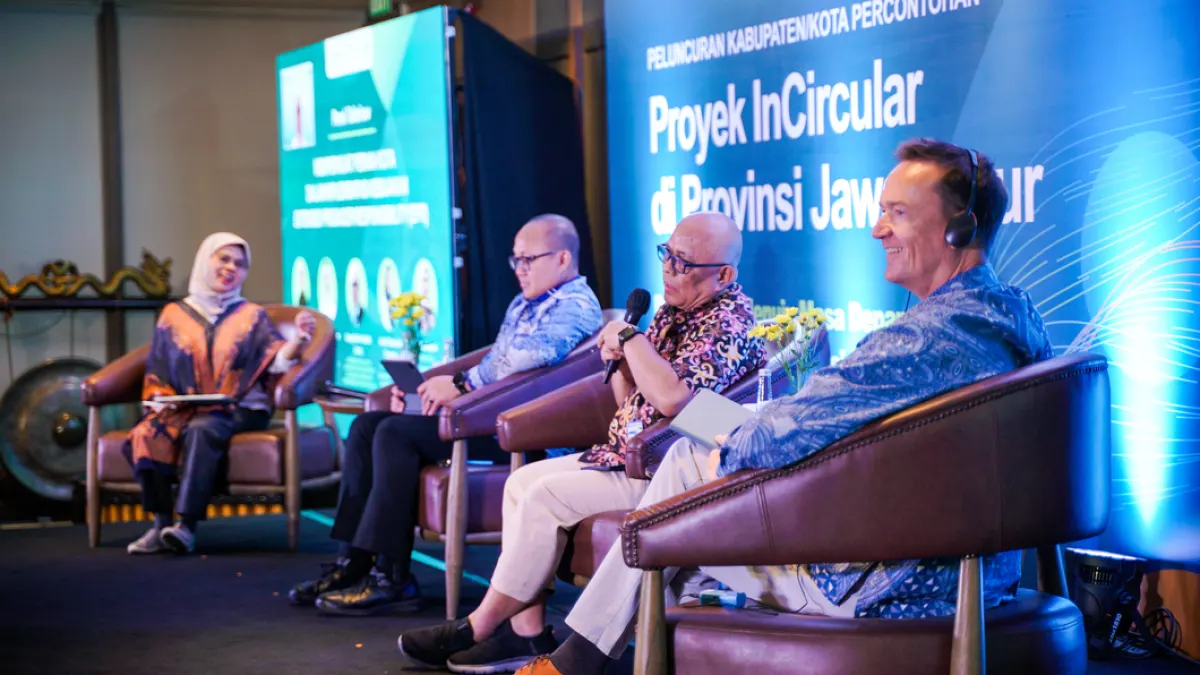
SURABAYA, GARISBUMI.com – Five cities and districts in East Java have been designated as pilot areas for strengthening the circular economy and waste management through the InCircular Project.
The five regions are Gresik Regency, Malang City, Malang Regency, Probolinggo City and Sidoarjo Regency. This joint commitment was confirmed by the Ministry of National Development Planning/Bappenas, the East Java Provincial Government, and the German Federal Government through the Deutsche Gesellschaft für Internationale Zusammenarbeit (GIZ) GmbH.
This collaboration is the first step to translating the national vision of a circular economy into real policies and actions at the regional level.
The InCircular Project is a technical collaboration between the Indonesian Government and the German Federal Government. This program is implemented by GIZ Indonesia & ASEAN with the mandate of the German Federal Ministry for Economic Cooperation and Development or BMZ.
The program supports the implementation of the Action Plan and Roadmap for Indonesia's Circular Economy 2025–2045.
Deputy for Food, Natural Resources and Environment at the Ministry of National Development Planning/Bappenas, Leonardo A.A. Teguh Sambodo, said that circular economic development requires a common vision and action from various parties.
According to him, regional governments have an important role in translating national development directions into policies, service systems and innovations that suit the conditions of each region.
"The circular economy is not only related to waste management, but also how resources are used more efficiently, products and materials retain their value as long as possible, and new economic opportunities can be created through cross-sector collaboration," said Leonardo in Surabaya, Tuesday (15/9/2026).
Five Regions Will Test Circular Economy Model
Carrying the spirit of "From the Regions, Towards an Indonesian Circular Economy", five pilot regions will identify problems, test various approaches, build partnerships, and formulate lessons to strengthen the implementation of a circular economy.
Implementation involves the central government, regional governments, development partners, the private sector, academics and community organizations.
It is hoped that this cross-sector collaboration will be able to turn the waste problem into an opportunity that produces sustainable economic, social and environmental benefits.
Deputy Governor of East Java, Emil Elestianto Dardak, said that the selection of East Java as the working area for the InCircular Project was both a matter of trust and a strategic opportunity.
"Through a circular economy, we encourage more efficient use of resources, reduce waste generation at the source, and strengthen reuse and recycling," said Emil.
According to him, the circular economy approach will strengthen the transformation of regional development towards more efficient, low-waste and sustainable resource use.
East Java's Waste Reaches 4.34 Million Tons Per Year
Strengthening the waste management system is an urgent need in East Java. Based on data from the National Waste Management Information System (SIPSN) 2024, waste generation in the province reaches around 4.34 million tons per year.
Meanwhile, SIPSN data in the Ministry of Environment and Forestry (KLH) and Forestry's Performance Report notes that plastic waste contributes around 19 percent of the composition of national waste in 2023.
The large amount of waste generation shows the need and opportunity to strengthen comprehensive resource management, from production and consumption processes to reuse and recycling of materials.
Director of Urban Development Cluster GIZ Indonesia & ASEAN, Thomas Foerch, said that the waste problem has a direct impact on people's lives so it requires a systemic and collaborative solution.
"Strong partnerships are the foundation for driving real change and delivering long-impact solutions," he said.
Thomas explained that the German Government's support through GIZ Indonesia & ASEAN is part of the cooperation between Indonesia and Germany which has been going on for 50 years. In recent years, the circular economy and waste management have become one of the priority sectors for cooperation between the two countries.
"The InCircular project was developed from the need to strengthen the implementation of Indonesia's Circular Economy Roadmap. Therefore, we welcome the five cities and districts that are taking steps together to be involved as pilot areas," he said.
Regions Prepared to Implement EPR
The Indonesian government also continues to strengthen waste management through the implementation of Extended Producer Responsibility or EPR. This policy places producers as parties who are also responsible for managing the product and its packaging after it is used by consumers.
Regional governments have a strategic role in strengthening the waste management system as well as preparing the implementation of EPR in their respective regions.
"In the future, technical support for the InCircular Project in the five pilot cities and districts will focus on strengthening the capacity of the waste management system to prepare for EPR implementation," said Thomas.
The InCircular project was launched in November 2025 and will run until 2029. This program focuses on strengthening the regulatory framework, increasing capacity, coordinating across stakeholders, as well as improving the waste management system in selected provinces and regions.
It is hoped that this technical collaboration will produce evidence-based policies that are able to strengthen economic resilience while realizing sustainable resource management.
Artikel ini merupakan siaran pers resmi yang diterbitkan melalui Meja Redaksi GARIS BUMI. Materi telah melalui peninjauan editorial untuk kenyamanan dan kejelasan informasi bagi pembaca.
Share Your Thoughts Editorial Moderation Required