
National Hotspots Jump to 932, Central Kalimantan (Kalteng) Records 643 Spots
JAKARTA, GARISBUMI.com – The number of Hotspots with a high level of confidence in Indonesia has jumped to 932 points. Central Kalimantan (Kalteng) is the most dominant region with 643 Hotspots or almost 70 percent of the total national findings.
Data from the Ministry of Forestry's Forest and Forestry Monitoring System or SiPongi shows that the number of Hotspots in the high confidence category on Tuesday, September 22 2026, at 21.20 WIB, increased by 244 points compared to the previous day which was recorded at 688 points.
This data was collected from NASA Terra/Aqua, SNPP, and NOAA-20 satellite monitoring.
Among the six priority provinces for handling forest and land fires or karhutla, the sharpest spike occurred in Central Kalimantan (Kalteng). The number of Hotspots in the province increased from 228 to 643 points.
West Kalimantan (Kalbar) recorded an increase from 36 to 50 points. Meanwhile, the number of Hotspots in South Kalimantan fell slightly from 71 to 68 points, while South Sumatra (Sumsel) decreased from 23 to 17 points.
Better developments were seen in Jambi and Riau. Jambi, which previously recorded two Hotspots, now has zero, while Riau still has no Hotspots in the high confidence category.
The following is the distribution of high confidence Hotspots in the six priority provinces:
- Central Kalimantan (Kalteng): 643 points
- South Kalimantan: 68 points
- West Kalimantan (Kalbar): 50 points
- South Sumatra (Sumsel): 17 points
- Jambi: nil
- Riau: nil
The Ministry of Forestry emphasized that Hotspots are an indication of surface temperature anomalies detected by satellites. Hotspots cannot be directly equated with a single fire incident or the area burned.
One fire event can be detected as multiple Hotspots. Therefore, all indications found via satellite must still be verified through direct inspection or groundcheck in the field.
Minister of Forestry and Head of BNPB Oversee Handling of Forest and Land Fires
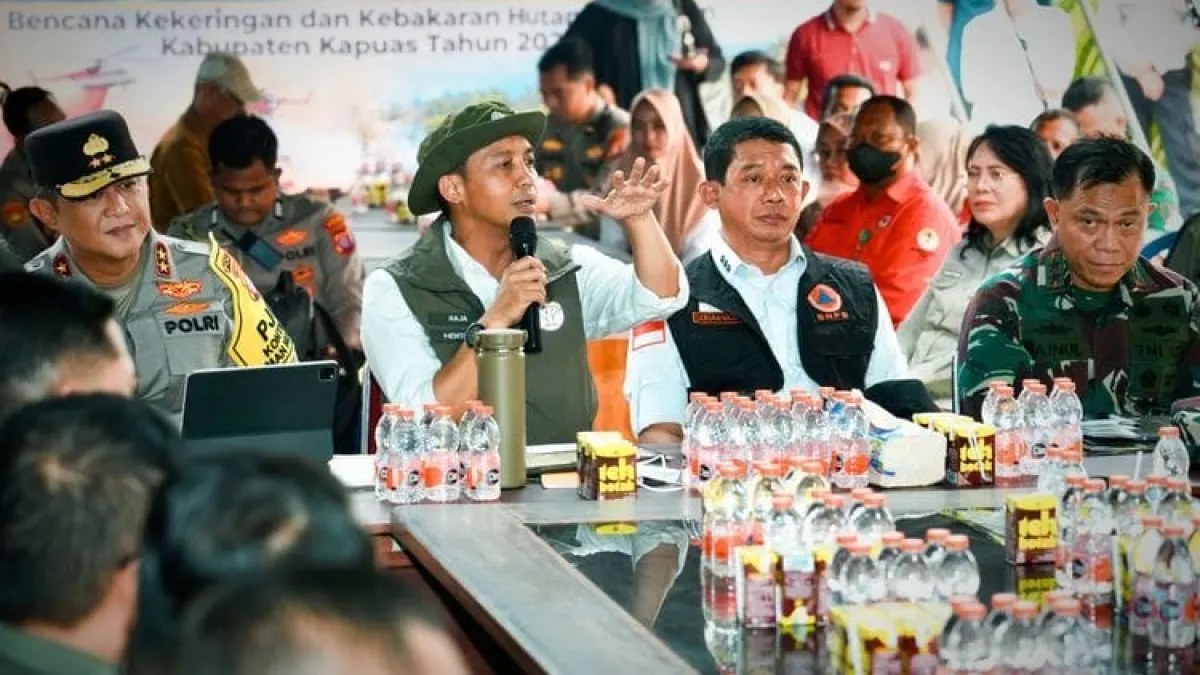
Minister of Forestry Raja Juli Antoni together with the Head of the National Disaster Management Agency, Lt. Gen. TNI Suharyanto, directly supervised operations to handle forest and land fires in Central Kalimantan (Kalteng), Tuesday, September 22 2026.
Both of them monitored Weather Modification Operations or OMC at the OMC Command Post at Tjilik Riwut Airport, Palangka Raya. Monitoring is carried out to see meteorological conditions, potential cloud availability, fleet readiness, and implementation of OMC to help clean up areas prone to forest and land fires.
OMC is one of the instruments for handling forest and land fires, especially to increase the wetting of peat ecosystems. However, implementation depends on the availability of potential clouds and flight conditions.
BNPB continues to implement OMC in Central Kalimantan (Kalteng) by taking advantage of every cloud opportunity detected by the Meteorology, Climatology and Geophysics Agency or BMKG.
From the OMC Command Post, the Minister of Forestry and the Head of BNPB continued monitoring at the Central Kalimantan (Kalteng) BPBD Disaster Management Operations Control Center. The evaluation focused on the development of fire Hotspots, the extinguishing process, distribution of personnel and equipment, as well as obstacles faced by officers.
Ground operations become increasingly important when thick smoke and limited visibility prevent helicopter flights for water bombing.
In the afternoon, the group visited the Kapuas Regency Karhutla Command Post. Coordination was carried out with the Regent of Kapuas, Central Kalimantan (Kalteng) Regional Police Chief, Pangdam XII/Tanjungpura, regional government, and related elements to ensure ground fire operations ran optimally.
This escort is a continuation of the activities of the Minister of Forestry and the Head of BNPB in Central Kalimantan (Kalteng) since Monday, September 21 2026. Their presence is aimed at shortening the coordination chain and adapting land and air operations to developments in field conditions.
Government Deploys 61 Air Fleet
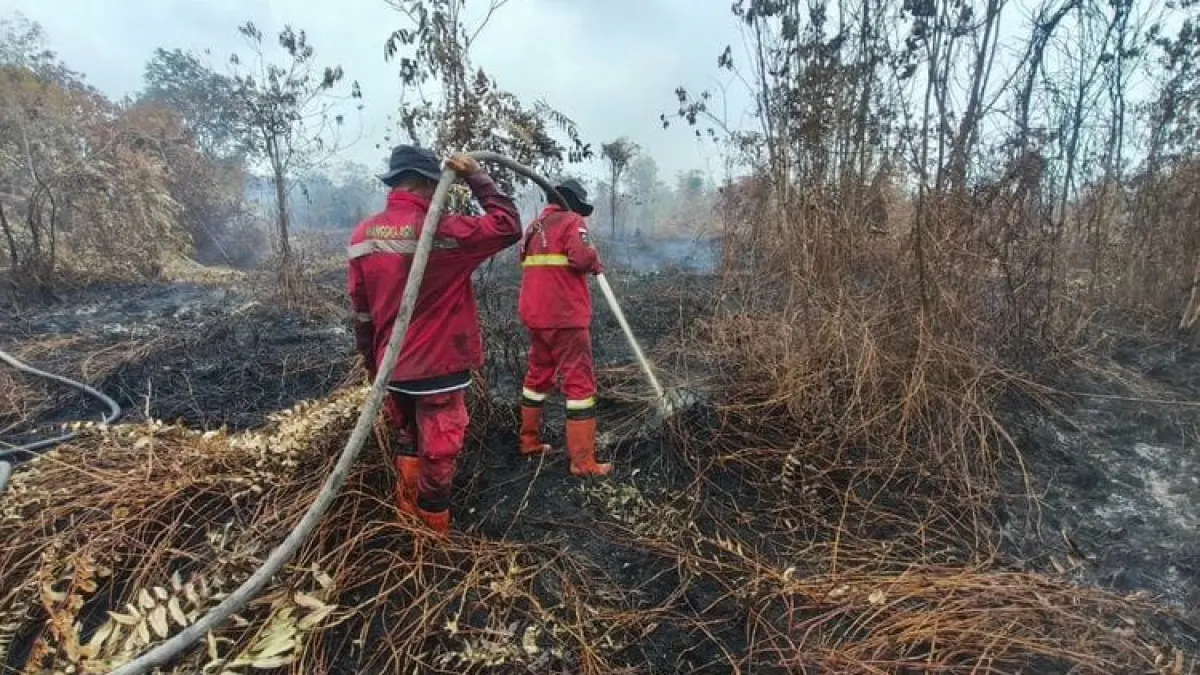
The government deployed 61 air fleets to support handling forest and land fires. A total of 17 units were used for patrols and OMC, while 44 units were deployed for water bombing operations.
Air fleet operations are adjusted to fire location, cloud potential, wind direction, smoke thickness, visibility and flight safety.
On land, Manggala Agni Ministry of Forestry together with BNPB, TNI, Polri, BPBD, local government, volunteers, community, business world, and related elements carried out patrols, ground checks, direct extinguishing, blocking fire spread, wetting and cooling.
Cooling of peatlands continues even though fire is no longer visible on the surface. Embers can survive underground and flare up again when the land dries out.
Air Quality in Several Areas Worsens
Monitoring the concentration of PM2.5 fine particles shows that air quality in Indonesia still varies. Most areas are in the good to moderate category.
However, a number of areas in Sumatra and Kalimantan recorded unhealthy to very unhealthy air quality. In some locations, air quality is even in the dangerous category.
This condition shows that handling forest and land fires cannot only be based on the number of Hotspots. The government must also monitor fire conditions in the field, PM2.5 concentrations, smoke distribution, air humidity, wind direction, chance of rain and visibility.
BMKG predicts that there is an opportunity for Cumulonimbus cloud growth from 23 to 29 September 2026 in a number of areas of Sumatra and Kalimantan.
These regions include Central Kalimantan (Kalteng), West Kalimantan (Kalbar), South Kalimantan, Riau, Jambi and South Sumatra (Sumsel). Weather information is one of the considerations in implementing OMC and air operations.
Residents Asked to Be Aware of Smoke Impact
The Ministry of Forestry urges people in affected areas to monitor air quality information and follow local government directions.
If air conditions worsen, people are advised to reduce outdoor activities and use masks if they have to do activities outside the home.
Special attention needs to be given to children, pregnant women, the elderly, and people who have respiratory problems or chronic diseases.
The public and business actors are also asked not to clear or clear land by burning. Every area manager is obliged to ensure the readiness of personnel, facilities, early detection and fire control systems.
People who find smoke, hot spots, burning activity, or affected wildlife are asked to immediately report to officers so that treatment can be carried out as early as possible.
Artikel ini merupakan siaran pers resmi yang diterbitkan melalui Meja Redaksi GARIS BUMI. Materi telah melalui peninjauan editorial untuk kenyamanan dan kejelasan informasi bagi pembaca.
Share Your Thoughts Editorial Moderation Required