Minister of Forestry and Norwegian Ambassador Visit Way Kambas, Strengthen Protection of Sumatran Elephants
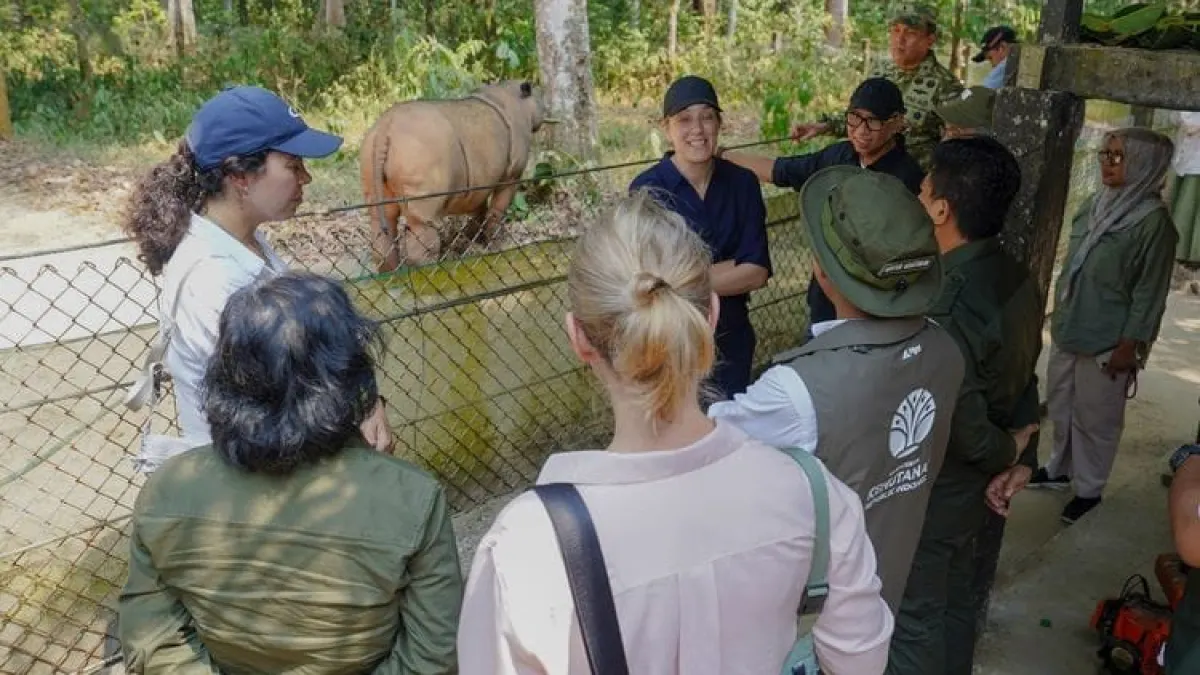
LAMPUNG, GARISBUMI.com – Minister of Forestry Raja Juli Antoni together with the Norwegian Ambassador to Indonesia Kaja Glomm reviewed integrated protection efforts in Way Kambas National Park (TNWK), Lampung, Sunday (20/9/2026).
The visit included controlling forest and land fires, mitigating negative interactions between humans and Sumatran elephants, improving the welfare of tame elephants, and conservation of the Sumatran rhino.
Raja Juli emphasized that Way Kambas must be maintained as a unified natural landscape. Protecting the area is not enough just to prevent fires and protect the habitat, but must also create a safe living space for animals and communities around the area.
The series of visits began with reviewing readiness to control forest and land fires in Way Kambas National Park. This conservation area has recently experienced a number of fire incidents.
This condition makes strengthening prevention, personnel preparedness, availability of water sources, and firefighting facilities and infrastructure a major concern.
In the field, the Minister of Forestry checked readiness to control forest and land fires and discussed various steps to strengthen prevention and response to fires.
Barriers for Elephant Conflict Mitigation
The group then reviewed the readiness of the barrier infrastructure that was built as part of mitigating negative interactions between Sumatran elephants and communities around the area.
During the review, Raja Juli was accompanied by the Chair of the Joint Committee for Mitigation and Handling of Negative Interactions with Sumatran Elephants, Brigadier General TNI Sriyanto. He explained the progress of infrastructure development and mitigation systems that were being prepared.
The existence of a barrier does not only function as a physical barrier. This infrastructure is designed to be part of an integrated mitigation system to reduce the possibility of elephants leaving conservation areas and entering residential areas and community land.
It is hoped that strengthening infrastructure and monitoring systems can provide a sense of security to the community while supporting better management of Sumatran Elephants.
Use of Elephant Chains Will Be Reduced
The attention of the Minister of Forestry and the Norwegian Ambassador was also focused on the tame elephants who have been assisting in conflict management and mitigation activities in Way Kambas.
Raja Juli explained that the elephants needed a gradual adaptation process. As barriers and regional security systems become more complete and functional, it is hoped that the use of chains on tame elephants will continue to be reduced.
Kaja Glomm then confirmed the direction of the policy to the Minister of Forestry.
"That's the ambition, to unchain?" asked Kaja, who wanted to confirm whether the ultimate goal was to free the elephant from its chains.
"Yes," answered King Juli.
The conversation showed the direction of improving elephant management in Way Kambas. The government wants to build a system that allows improving the welfare of elephants without neglecting the safety of the public, staff or animals.
However, the transition towards reducing chain use must be gradual. The implementation takes into account the readiness of infrastructure, behavior and adaptability of each individual elephant, as well as the effectiveness of the area security system.
Conservation Must Be Interconnected
The visit emphasized that Way Kambas conservation requires an interconnected approach.
Controlling forest and land fires is needed to protect habitat from damage. Mitigating human and elephant interactions is needed to create a safe living space. Meanwhile, the development of science and technology opens up new opportunities to save species with increasingly limited populations, including the Sumatran Rhino.
Collaboration with various parties, including international partners, is an important part of strengthening biodiversity protection in Way Kambas National Park.
Artikel ini merupakan siaran pers resmi yang diterbitkan melalui Meja Redaksi GARIS BUMI. Materi telah melalui peninjauan editorial untuk kenyamanan dan kejelasan informasi bagi pembaca.
Share Your Thoughts Editorial Moderation Required